
AI May Be the Future, But Talent is What Builds Security
While AI is reshaping the threat landscape, the people defending against those threats remain vital.

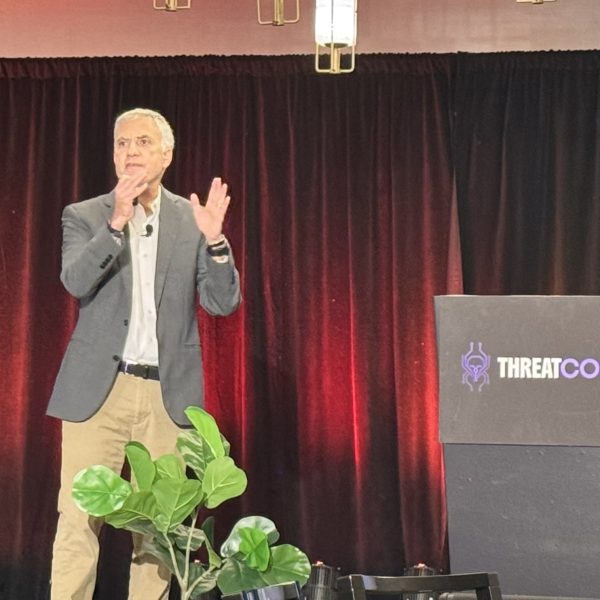
While AI is reshaping the threat landscape, the people defending against those threats remain vital.
RESTON, VA–The world can be a scary and uncertain place, especially for people like Paul Nakasone, who until quite recently had one of the more privileged and potentially insomnia-inducing views of the threat landscape as director of NSA. Knowing what’s actually happening across the world’s networks and what the most powerful adversaries are up to on any given day is not a recipe for a calm, quiet life.
Nakasone retired in 2024 as both director of NSA and commander of U.S. Cyber Command, and his tenure overlapped with not just the peak activity of the most capable state-backed actors on the scene, but also the emergence of wildly powerful AI tools that are now creating legions of new challenges for defenders and intelligence agencies alike. Speaking at the VulnCheck THREATCON1 conference here, Nakasone characterized today’s threat landscape as the most significant period of ongoing adversarial activity the United States has faced since World War II.
“The opportunities and challenges of the future are tied to AI. The way we’re going to be able to harness this technology is tied to our future,” he said. “Today in AI it’s all about compute. Can you bring the energy and chip capacity to build the models? Right now only two countries in the world can do that and it’s China and the U.S.”
Reflecting on the shifting realities of global intelligence and national security, Nakasone emphasized that the nature of threats is changing rapidly, driven by increasingly capable state actors and the transformative—and often unpredictable—role of AI.
The Shift in Adversarial Tactics
Nakasone saw a profound shift in the behavior of major foreign adversaries during his address. He specifically pointed to the evolution of China’s cyber operations, observing that the nation has moved away from being an actor that didn’t much care who knew what they were up to, to a stealthier, more embedded presence within U.S. critical infrastructure.
“I remember when China was a loud, noisy actor. They're no longer a loud noisy actor, highlighted by the fact that they’re in our critical infrastructure. That’s a very powerful actor,” he said.
The threat from Iran, by contrast, is defined less by technical supremacy and more by "high intent" and a lack of restraint. Nakasone pointed to recent water infrastructure attacks in several U.S. states as an example of a likely Iranian operation.
“They have very little governor or muffler on their activity. Iran may not have the highest capabilities but they have very high intent,” Nakasone said.
AI and the New Compute Arms Race
Central to the future of national security operations and challenges is the rapid adoption of AI. Nakasone characterized AI as a critical pivot point for the future of intelligence work, saying that the ability to harness this technology will define success in the coming years.
And the future that AI is shaping is coming faster than most people can imagine or deal with.
A Philosophy of Vigilance and Resilience
Moving forward, Nakasone argued that the U.S. must rethink its strategy, moving away from unilateral approaches in favor of a series of robust alliances. He suggested that national security must now be built on a foundation of stronger partnerships and a more coherent public narrative, ensuring the country can effectively navigate a climate where traditional boundaries of cyber warfare are increasingly blurred.
The key, he said, is the people, not the technology.
“I know having run the premier intelligence organization in the U.S., the secret is it’s all run by talent. We could lose tech and tradecraft and it would all be rebuilt by talent,” Nakasone said.
“I’m an incredible optimist about the future. The more I’ve worked with this industry, the more I see incredible capacity and capability.”